
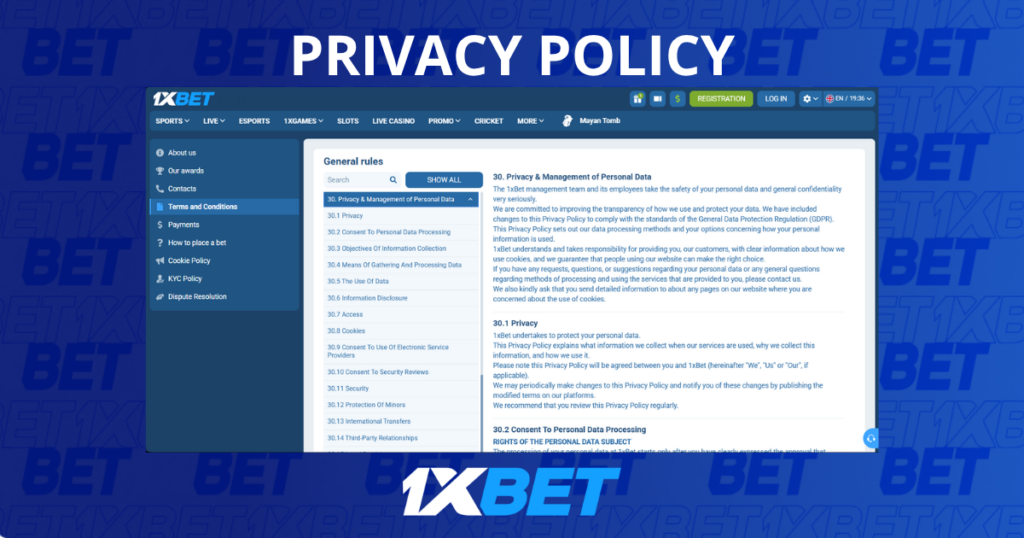
Every registered account creates a digital record that requires secure processing. The 1xBet Privacy Policy explains what information the platform collects, why each category is needed and when disclosure is permitted. These rules apply to registration, identity checks, payments, technical activity and marketing preferences. They also specify the controls available to customers. Exact rights, storage periods and breach procedures depend on the legislation governing each account.
Personal Data Categories
Creating an account requires sufficient information to identify the customer and confirm eligibility. Additional records appear during verification, payment processing and routine use of the Online Casino. Submitted details must remain accurate. A mismatch between an identity document and the account profile may trigger another check or a temporary restriction.
| Data category | Typical examples | Main purpose |
| Identity | Full name, date of birth, nationality | Age and identity verification |
| Contact | Address, email, telephone number | Account communication |
| Verification | ID copy, proof of address, facial image | KYC and fraud checks |
| Financial | Payment details, deposits, withdrawals | Transaction processing |
| Technical | IP address, browser, device, activity log | Security and service analysis |
Automatically generated records may include login dates, visited pages and software crash reports. Such information helps identify unusual access and technical faults.
Legal Bases for Processing
Not every operation relies on consent. Information may be processed when it is necessary to manage an account, fulfil a legal obligation or protect the 1xBet Betting Company against fraudulent activity. A valid legal basis must support each stated purpose.
- Contract: provides account access and enables bets, payments and support.
- Legal obligation: covers age checks, identity verification and mandatory disclosures.
- Legitimate interest: supports fraud detection and security investigations.
- Consent: applies to optional marketing and separately approved activities.
- Vital interest: permits exceptional action needed to protect a person.
When consent is given, the system can record the time and accepted policy version. It may later be withdrawn. However, services can become unavailable if the rejected processing is essential for account operation. Statistical analysis may use anonymised records that no longer identify an individual.
Cookies and Tracking Tools
Small browser files retain selected settings and measure activity during a visit. The platform distinguishes between temporary records and files kept for a defined period. Customers can remove stored cookies or prevent the browser from accepting new ones.
- Session cookies operate during one visit and expire when the browser closes.
- Persistent cookies remain until their assigned expiration date.
- Analytical cookies measure traffic and record how services are used.
- Necessary cookies support registration, protected areas and financial operations.
Disabling every category may prevent some functions from working correctly. A chosen interface language, for example, might not remain active after the next visit. Private browsing limits certain files stored on the device, but it does not stop all server-side logging.
Third-Party Data Sharing
Some operations require an external provider, while others involve mandatory cooperation with public authorities. In each case, a recipient should obtain only the records needed for its assigned function. Cross-border processing is possible when a contractor operates in another jurisdiction.
- Payment operators receive information required for deposits, withdrawals and refunds.
- Verification services may compare submitted documents with authorised databases.
- Technical contractors can access limited records for hosting or security work.
- Regulators may request information through a valid legal procedure.
- Corporate partners must follow contractual confidentiality requirements.
A card or electronic-wallet transaction cannot be completed without sending selected account and payment details to the relevant processor. This transfer does not grant unrestricted permission to reuse the information for unrelated commercial purposes.
User Rights and Data Control
The controls available to an account holder depend on applicable legislation. Before releasing or changing private records, the company may request proof of identity. This additional check reduces the risk of information being obtained by an unauthorised person.
| Right | Practical result |
| Access | A customer can request information about stored personal data |
| Correction | Inaccurate or incomplete details can be updated |
| Deletion | Eligible records may be erased when no lawful reason requires retention |
| Restriction | Certain processing may be paused during a review |
| Objection | Operations based on specific interests may be challenged |
| Consent withdrawal | Optional processing can be stopped |
| Complaint | A matter may be referred to the relevant supervisory authority |
Closing an account does not always produce immediate deletion. Transaction and verification records can remain stored while financial, anti-fraud or statutory duties continue. Therefore, one retention period cannot apply to every data category.
Policy Updates and Breaches
Updates can follow changes in legislation, technology or the services offered through 1xBet. Recording the accepted version and timestamp shows which terms were presented during registration. Significant amendments should be examined before the account is used again.
- Revised terms may alter processing purposes or recipient categories.
- Account notices can announce material amendments.
- Suspected exposure should be reported to support without delay.
- Access may be restricted while affected systems are investigated.
- Notification duties depend on the relevant data-protection rules.
False details or refusal to complete a required security check may result in limited access or account closure. If the company fails to meet its obligations, possible consequences include corrective orders, compensation claims and regulatory penalties. A single worldwide fine cannot be stated because enforcement standards differ between jurisdictions.